
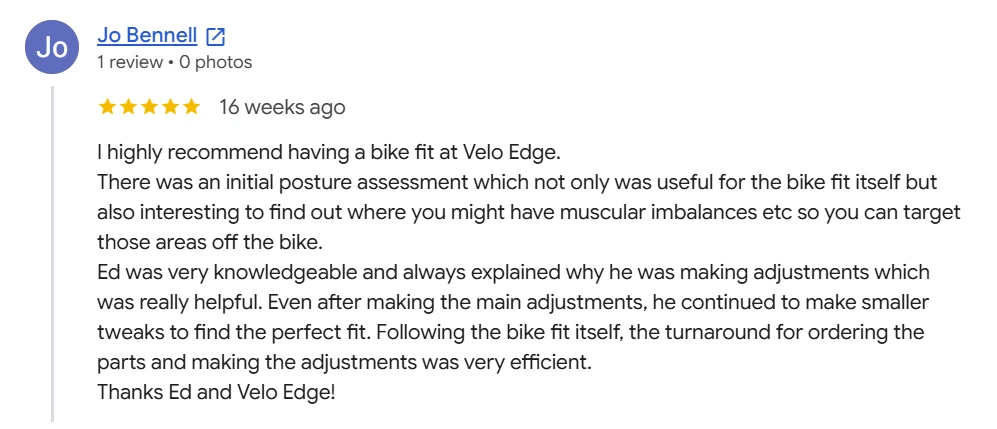
This case study follows the work between Ed Donne, a bike fitter here at Crimson Performance and Jo Bennell, a keen cycling enthusiast and now one of our regulars on the Saturday shop rides. This article follows our bike fit process and subsequent positional work on Jo’s bike, illustrating the care and attention to detail we’re renowned for here at Crimson Performance.
This bike fit was my first time working with Jo, and as such our screening process was vital in understanding how to solve the issues she was experiencing with her current setup. Jo was unfortunately suffering immediate saddle discomfort, as well as pain in her shoulders, neck, and posterior knee which would persist and worsen as she covered more distance. This prevented her from completing her training rides in comfort, which is essential given that she is covering up to two hundred kilometres weekly across multiple sessions.
Being a keen triathlete, her training is varied across cycling, swimming, and running, all of which are sports which require different conditioning and training. A rider’s current and previous sporting endeavours greatly impact their interaction with the bike, especially if they have suffered any injuries. Thankfully, in Jo’s case, there were no such injuries.
Once this had been ascertained, I focused on screening for any postural asymmetries in stance and range of movement parameters. I noted a slight supination of the left foot in stance, as well as a misalignment of the pelvis. With these results recorded, I could then assess Jo’s current cycling position, drawing on my initial observations and the screening data to explain why she was experiencing discomfort on her bike.
Throughout Jo’s time on both her Merida and the Purely Custom fitting jig, we incorporated the use of our Gebiomized saddle pressure mapping pad, which provides several key insights into a rider’s saddle interaction, quantifying the total pressure distributed throughout the saddle pelvic stability, fore/aft and lateral engagement. It became clear that excessive saddle height and setback on Jo’s bike was causing her to sit in a very forward position on the nose of the saddle. This typically causes excessive load on the pudendal nerve rather than the sit bones and Pubic Rami (bridges of the pelvis). It is vital when setting up a rider’s saddle height that these bone structures are well engaged because they are able to tolerate far higher pressure load than the pudendal nerve.
In absorbing the dysfunction of excessive saddle height and setback, Jo was being forced to over-engage her Tricep, resulting in the immediate discomfort across her shoulders and neck. It also transpired that the handlebar width was excessive, causing excessive load on not only the Triceps and shoulders, but also through the hands and wrists. This screening, on-bike assessment and initial saddle pressure mapping allowed me to effectively designate time to test and validate changes to her bike fit on our Purely Custom fitting jig.
We began by conducting some biomechanical analyses on key areas for testing bike position using our Dartfish motion capture system. We utilise leg extension for saddle height, centre of mass for saddle setback, shoulder extension for total reach and finally ankling angle. I reduced Jo’s saddle height 22mm such that her leg extension was within the optimal parameters and this was met with very positive feedback. Jo felt as though she could produce more power with more comfort.
Our next adjustment was to reduce saddle setback by 15mm to balance the centre of body mass on the bike. While this helped Jo to better engage her hamstrings in the downward motion of the pedal stroke, it still left a feeling of excessive load through the Trapezii. I focused then on narrowing the handlebar width such that Jo wouldn’t be forced to inwardly rotate her wrist and relieve pressure on not only the Trapezii, but also the Median and Ulnar nerves.
Jo reflected that this had helped with the load through the hands and wrists, but the load through the upper back and shoulders still persisted. I then experimented with a combination of a 20mm reach reduction to help reduce Jo’s shoulder angle, and lowering of handlebar stack by 24mm to ease load on the shoulders. This yielded good results and much better biomechanical analyses.
I focused next on Jo’s crank length. With Jo now engaging the Ischial Tuberosites at the rear of the saddle very effectively, it became apparent to me that her current crank length was excessive for her optimal saddle height. We shortened them from 165mm to 160mm and after positive feedback in relation to power and comfort, we validated this change with a Gebiomized saddle pressure shot.

Left: start position. Right: final position.

Left: start position. Right: final position.

Left: start position. Right: final position.
These final pressure shots illustrate the positive effects of the changes which we made to Jo’s setup on the jig, reducing the overall peak of pressure by over fifty-percent, combined with better fore/aft on the saddle and a more balanced lateral distribution of pressure. The pelvis (the red line in the images) is also noticeably more stable. Through testing and validation of changes on the fitting jig, I was able to provide Jo with an optimal set of bike fit metrics, which I could then interpret to give her guidance as to the necessary adjustments and component swaps to her Merida Reacto.
The optimal saddle height was 626mm rather than 648mm; the optimal setback was 36mm rather than 51mm; the optimal reach was 595mm rather than 640mm; and finally the optimal saddle to bar drop was 17mm rather than 19mm.
It took a couple of component swaps to achieve Jo’s optimal position from the fitting jig. We fitted 160mm cranks through changing the chainset and managed to achieve optimal handlebar width and a considerable reach reduction through a narrower, shorter reach handlebar. We had also needed to take out 20mm of stem stack in order to achieve the saddle to bar drop, given the saddle height reduction. It is also important to note that Jo and I tested several different saddles throughout her time on the fitting jig, but it was the original which yielded the best pressure shot and feedback.
It is always rewarding to make a difference to any cyclist through improving their bike fit, be it increasing power, comfort, or a combination of the two. Jo’s feedback throughout the process was also so valuable in the testing and subsequent implementation of changes. This case study really does illustrate how seemingly small changes can make such a huge difference to a rider’s comfort and performance. We hope to see Jo on both our Saturday and Sunday shop rides into the future!
Written by Ed Donne, IBFI Certified Bike Fitter at Crimson Performance.
Explore the Ultimate Bike Fit with Ed Donne at our Alderley Edge studio.